Upper vs Lower Antelope Canyon: Which Should You Visit?
Upper vs Lower Antelope Canyon compared — light beams, stairs, crowds, price and difficulty — so you can pick the right Navajo-guided slot canyon tour.
The single most common question travelers ask before booking is whether to visit Upper or Lower Antelope Canyon. They sit just a few miles apart outside Page, Arizona, both carved into the same glowing Navajo sandstone, and both can only be entered on a Navajo-guided tour. But they are genuinely different experiences — and the right choice depends on what you want to photograph, how steady you are on your feet, and how much you want to spend. This guide breaks down the differences so you can book with confidence. If you already know you want the classic light-beam corridor, you can check Upper Antelope Canyon availability on our homepage.
The Short Answer
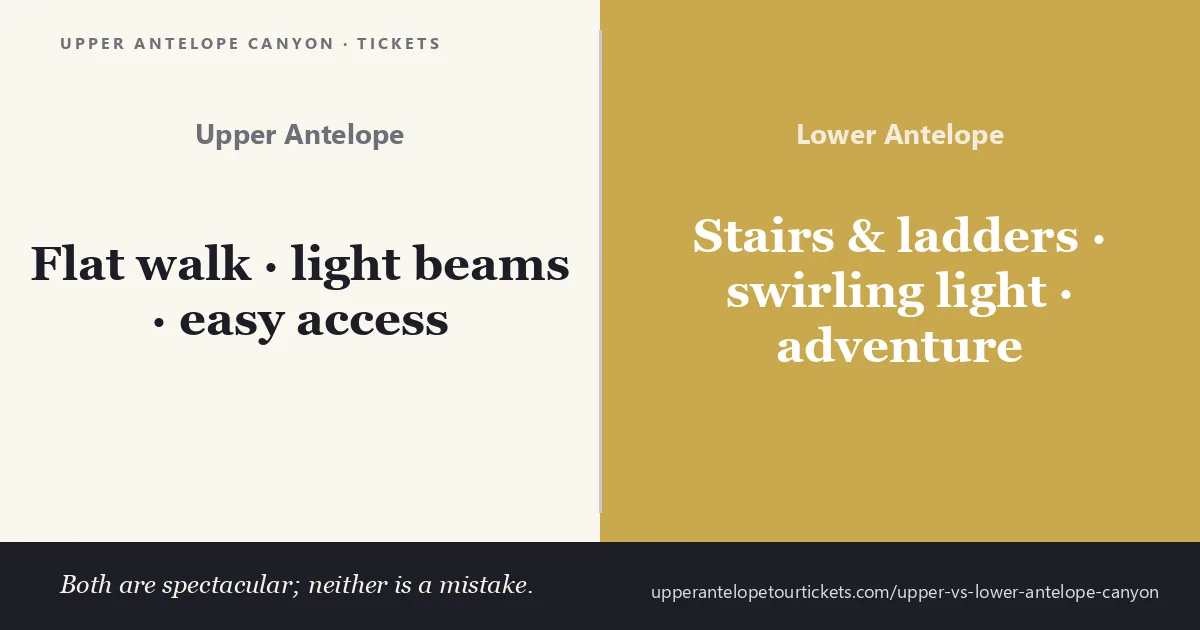
Choose Upper Antelope Canyon if you want the famous shafts of light, an easy flat walk with no stairs, and the most iconic slot-canyon scenery. Choose Lower Antelope Canyon if you prefer a quieter, often slightly cheaper visit and you don’t mind descending steep metal stairs and ladders. Both are spectacular; neither is a mistake.
Two Separate Canyons, Two Separate Operators
Upper and Lower Antelope are not two ends of the same walkway — they are distinct canyons with separate entrances on Navajo Nation land, run by different Navajo-authorized tour operators. You book each one separately, and you can absolutely do both in a single day if you have the energy. (If that is your plan, a combined Upper + Lower guided tour is the simplest way to see them back-to-back.)
The Navajo name for Upper Antelope Canyon is Tsé bighánílíní, meaning roughly “the place where water runs through rocks” — a reminder that these corridors were sculpted by flash floods over thousands of years and remain a sacred place to the Diné (Navajo) people.
How the Canyon Formed — and How It Was Found
Both canyons are carved into Navajo Sandstone, the petrified remains of Jurassic-age sand dunes. Their flowing, ribbon-like walls were shaped over thousands of years by flash floods tearing abrasive sand and water through the rock, with wind smoothing the rest — the very process the name Tsé bighánílíní (roughly Tseh-bee-ghah-nee-lee-nee) records.
The canyon came to wider attention relatively recently. Navajo tradition credits its discovery to a young girl who came upon it around 1931 while herding her family’s sheep and followed the flock into its cool, shaded depths. For the Diné it is a sacred place rather than a mere attraction — part of why every visit is led by an authorized Navajo guide, and why staying with your group and following your guide’s lead is simply how you visit Tsé bighánílíní with respect.
Upper vs Lower at a Glance
| Feature | Upper Antelope | Lower Antelope |
|---|---|---|
| Shape | Wide at the bottom, narrows at top (A-shape) | Narrow at the bottom, opens at top (V-shape) |
| Walking | Flat, sandy floor — no stairs | Steep metal stairs and ladders |
| Light beams | Yes — the classic spot | Rare; better for swirling light, not beams |
| Crowds | Busier, especially midday | Often a little less crowded |
| Effort | Easy for most able-bodied visitors | Moderate — climbing required |
| Typical entry | Guided tour from around $95 | Guided tour, often slightly less |
| Best for | Light beams, easy access, photos | Adventurous walkers, swirling forms |
Why Most First-Timers Pick Upper
Upper Antelope Canyon has a flat, sandy floor at ground level, so there is no climbing — you walk straight in from the open-air shuttle. Its tall, narrow opening at the top is exactly what produces the dramatic light beams that pour down to the canyon floor around the middle of the day in summer. Because it is the most photographed slot canyon in the world, it is also the busiest, and prime midday slots sell out first.
Our featured Navajo-guided Upper Antelope tour starts from $95 per person, holds a 4.5-star rating across more than 2,600 guest reviews, and bundles the entry ticket, the Navajo Parks permit handling, the open-air shuttle, and your authorized Navajo guide into one booking. You spend roughly 1 to 1.5 hours inside the canyon, with about two hours total once the short shuttle ride is included.
Why Some Visitors Prefer Lower
Lower Antelope rewards a little more effort. You descend into it on a series of steep stairways and ladders, which rules it out for anyone with mobility limitations but makes for a more adventurous walk. Its V-shaped cross-section catches softer, swirling light rather than focused beams, and many photographers love it precisely because it feels less staged. It is generally a touch cheaper than Upper, and crowds can be marginally thinner.
Accessibility: An Important Difference
This is where the two canyons truly diverge. Upper Antelope is far more accessible — a flat walk suitable for most able-bodied visitors of all ages. However, Antelope Canyon tours in general do not permit hiking sticks, canes, walkers, or wheelchairs, and tours are not suitable for guests with significant mobility impairments, heart conditions, or pregnancy. Lower Antelope’s stairs and ladders make those restrictions stricter still. If anyone in your group has limited mobility, Upper is the only realistic option — and even then, review the operator’s requirements before booking.
Can You See Both in One Day?
Yes. The two entrances are only a few miles apart, and a combined Upper + Lower Antelope Canyons guided tour lets you experience both in a single half-day outing — useful if you have come a long way and want the full contrast between the flat beam-lit corridor and the narrow, ladder-strewn descent. It costs more than a single canyon, but it removes the hassle of booking two operators separately.
Our Recommendation
For a first visit — especially if you want those iconic light beams and an easy walk — book Upper Antelope Canyon. It delivers the picture-postcard scenery with the least physical demand. Save Lower for a return trip, or add it on as a combo if you are a keen photographer who wants both.
Ready to Book?
The light beams, the flat sandy floor, and the glowing sandstone of Tsé bighánílíní are waiting. Every tour on our site is Navajo-guided by law, with the entry ticket, permit, and guide included. See the featured Upper Antelope Canyon tour and check availability.
See the Light Beams of Upper Antelope Canyon
Join 2,600+ guests on a Navajo-guided walk through Tsé bighánílíní. Every tour includes your Upper Antelope Canyon entry ticket, the Navajo Parks & Recreation permit, and an authorized Navajo guide — with free cancellation up to 24 hours before.
Check Availability & Book